
Citations
Compare cited sources by domain, host, or page and inspect the answers that used them.
View as MarkdownOpen Citations to investigate the sources recorded in tracked AI answers. A citation occurrence is not a website visit, backlink, or unique person.
Narrow the source list
- Set the date range and All filters.
- Choose All sources, You, Competitor, Social, UGC, or Third-party.
- Select grouping By domain, By host, or By page.
- Sort by Citation share or another available column, then open a source to inspect its supporting pages and prompts.
Domain grouping combines a site's hosts; host grouping keeps hostnames separate; page grouping focuses on individual URLs. Classification into social, user-generated content, or page types is a useful organizing aid, not a guarantee about editorial quality or ownership.
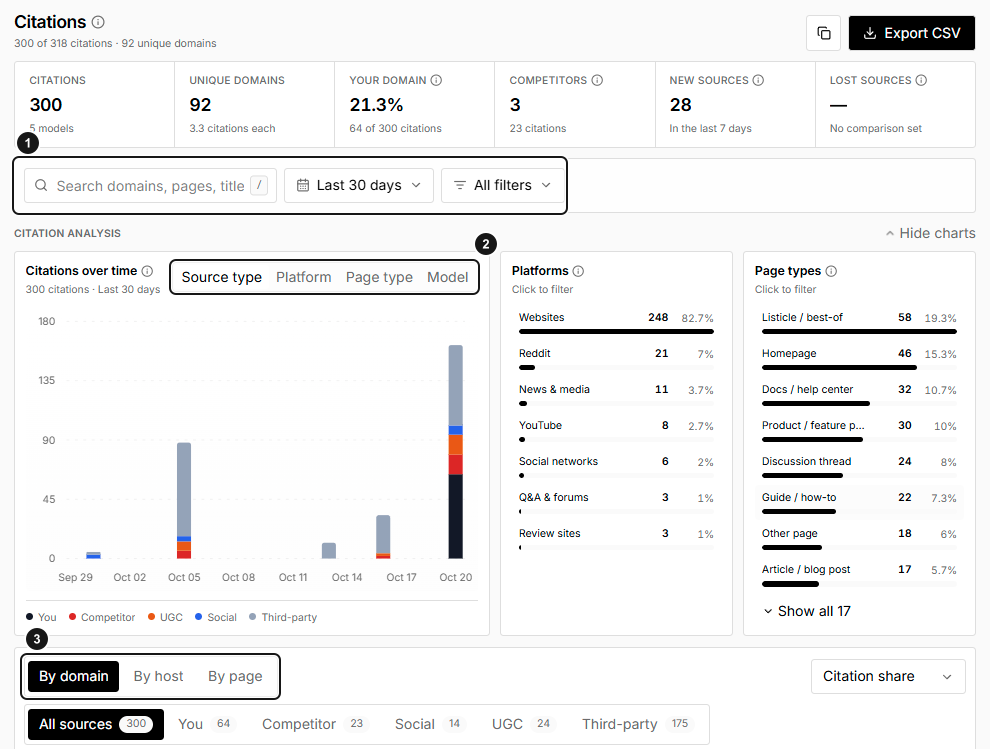
EarlySEO example snapshot. 1. Search, date and filters. 2. Compare source, platform, page type or model. 3. Group by domain, host or page. The displayed sources and counts reflect this example scope, not website visits.
Read the table and charts
| Field | Meaning |
|---|---|
| Citation share | This source group's citation occurrences divided by all citation occurrences in the filtered source set |
| Citations | Recorded citation occurrences, including repeated use across answers |
| Prompts | Distinct tracked prompts represented by the group's citations |
| Avg. pos. | Average valid recorded citation position, not organic search rank |
| Page mix | Distribution of classified page types |
| Last seen | Latest recorded occurrence for the displayed source evidence |
Citation share is different from a response-based citation rate. For example, a source with 10 of 50 citation occurrences has a 20% citation share even if those occurrences came from fewer than 50 responses. This is an illustrative example, not customer data.
In Citation analysis, split trends by Source type, Platform, Page type, or Model. Hide charts leaves more room for the source table. Platform and page-type panels retain alternative choices when their own facet is selected, so their distributions need not match a narrowly filtered table exactly.
When a comparison period is active, a source can appear because it was cited previously but not in the primary period. Inspect its period labels before treating it as a current citation.
Inspect a source
Open its detail view and follow the available page, prompt, and response evidence. Compare your domain with specific competitors rather than assuming every third-party source is a competitor. Use Export CSV when you need the source table outside EqualAI.
Troubleshooting
- A domain appears more than once: check whether grouping is by host or page.
- Share changed without a count increase: the total number of citations in the denominator may have changed.
- No citations appear: check filters and whether the selected answers actually contain source data.
- A page-type label looks wrong: verify the underlying URL and content; classification is not a manual editorial review.